
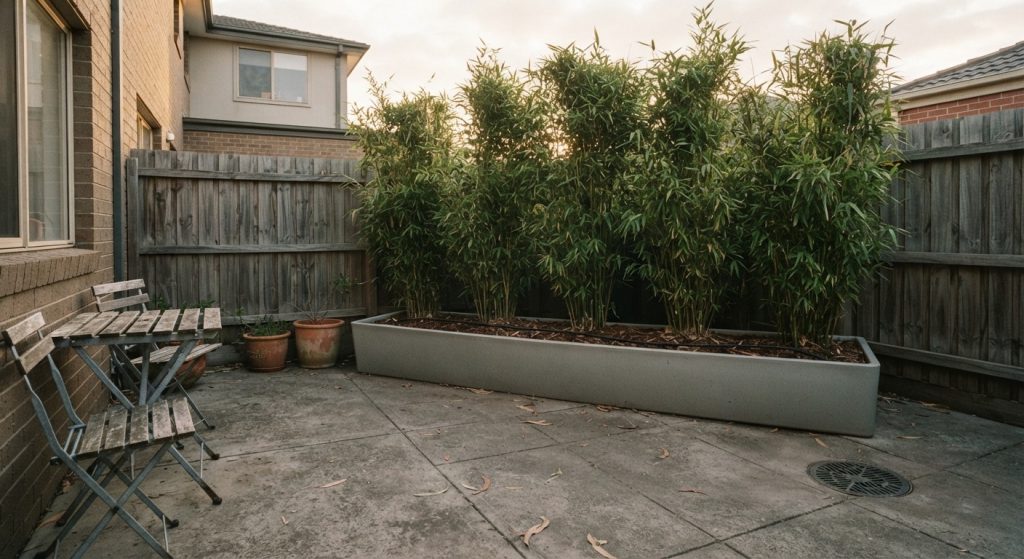

The body corporate rules said no permanent structures above the fence line. The neighbour’s kitchen window looked straight onto the courtyard table. And the courtyard itself was concrete, wall to wall, with a single drain in the corner and nowhere to dig.
A row of planters fixed all three problems, though not on the first attempt.
Pot Size Decides Almost Everything
Bamboo in a container lives or dies on root volume. The first attempt in that courtyard used 400mm round pots, which looked tidy for about eighteen months before the clumps filled them, dried out by lunchtime on any day over 30 degrees, and started browning off from the tips. A trough around 500mm deep and at least 450mm wide gives a clumping variety enough room to settle and hold moisture through a Melbourne January. Go bigger if you can. Nobody has ever complained that a planter holds too much soil.
Long troughs beat a line of separate pots for bamboo screening, and not just for looks. One continuous planter lets neighbouring clumps share a single soil mass, so they dry out more evenly and the gaps between plants close faster at the base, where individual pots always leave a visible break.
Balconies Have a Weight Limit Nobody Mentions
Wet potting mix weighs somewhere around a tonne per cubic metre. A two-metre trough at 500mm deep and wide holds half a cubic metre, so you’re looking at roughly half a tonne once it’s watered, before you add the plants or the planter. Check with the building manager or an engineer before that lands on a balcony slab.
Lightweight fibreglass planters take a fair chunk off the total, which is why they show up on so many apartment balconies. Corten and other steel planters look great at ground level but cop the full afternoon sun on a west-facing wall and cook the roots against the metal. Line the inside with foam board or keep them out of the worst of the heat.
Picking a Variety That Tolerates a Container
Plenty of clumping bamboos handle pots, but some handle them better than others.
Bambusa textilis gracilis, the usual screening favourite, grows upright and narrow and stays tidy in a trough
Bambusa multiplex types (Alphonse Karr, Goldstripe) also cope well, and the striped canes look good up close
Anything that wants to arch outward over two or three metres? Skip it for balconies
Running bamboo, never
In a container, expect a shorter screen than the same plant would reach in the ground. Three to four metres is common for gracilis in a decent-sized trough, against five or six in open soil, which suits most courtyards fine since you’re usually blocking a window, not a two-storey wall.
Water Is the Job Now
Ground-planted bamboo eventually looks after itself. Potted bamboo doesn’t, ever. On a hot, windy day a planter on a north-facing balcony can lose most of its moisture in a single afternoon, and bamboo shows thirst fast, with leaves rolling inward lengthwise to cut water loss. If you see that, water straight away.
A simple drip line on a timer makes this manageable. Without one, plan on watering most days from December to March, and every two or three days in milder months. Mulch on top of the potting mix helps more than people expect. So does a slow-release fertiliser high in nitrogen in early spring, because the plant can’t go hunting for nutrients beyond the walls of the planter, and it uses up whatever the potting mix started with inside a year or two.
Dividing the Clump Every Three to Five Years
Eventually the clump fills the trough so completely that there’s more root than soil. Water runs straight through, the new shoots come up thinner each season, and the plant starts to look tired even with regular feeding. That’s the signal. Tip it out in late winter, cut the root mass into two or three sections with a pruning saw (it’s hard work, and a sharp spade won’t do it alone), replant one section with fresh mix, and pot the rest up or give them away. Dividing in spring works too, but it usually costs you that season’s new shoots.